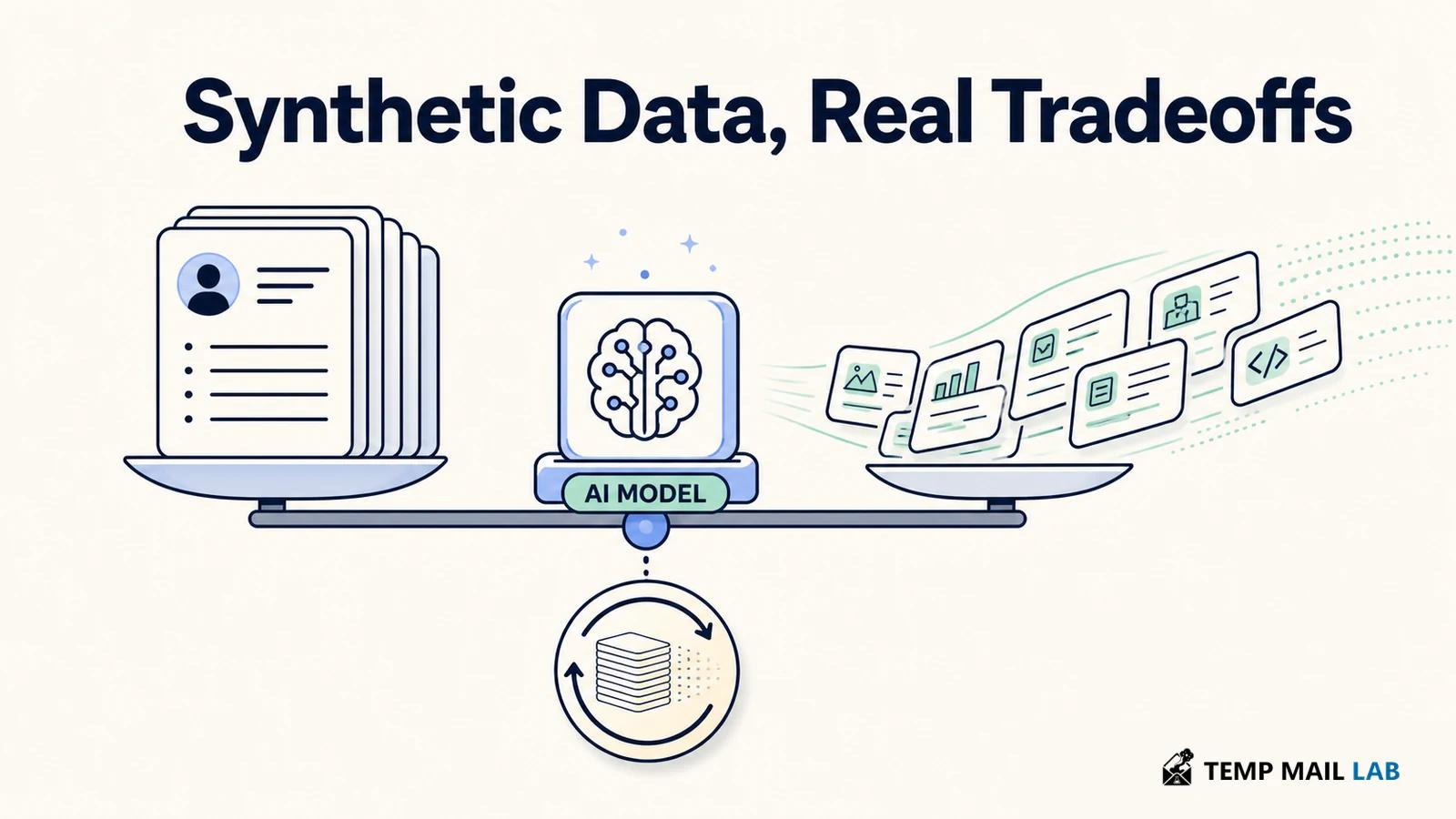
A training dataset can be huge and still leave a model poorly prepared for the world it must handle. Text scraped from the open web is not the same as a balanced sample of human experience, and synthetic examples do not automatically repair that gap.
Synthetic data can make rare cases easier to represent, reduce exposure to personal information, and create labels that are expensive to collect. It can also repeat a model's assumptions, hide errors behind polished output, and crowd out the human examples that keep a system grounded.
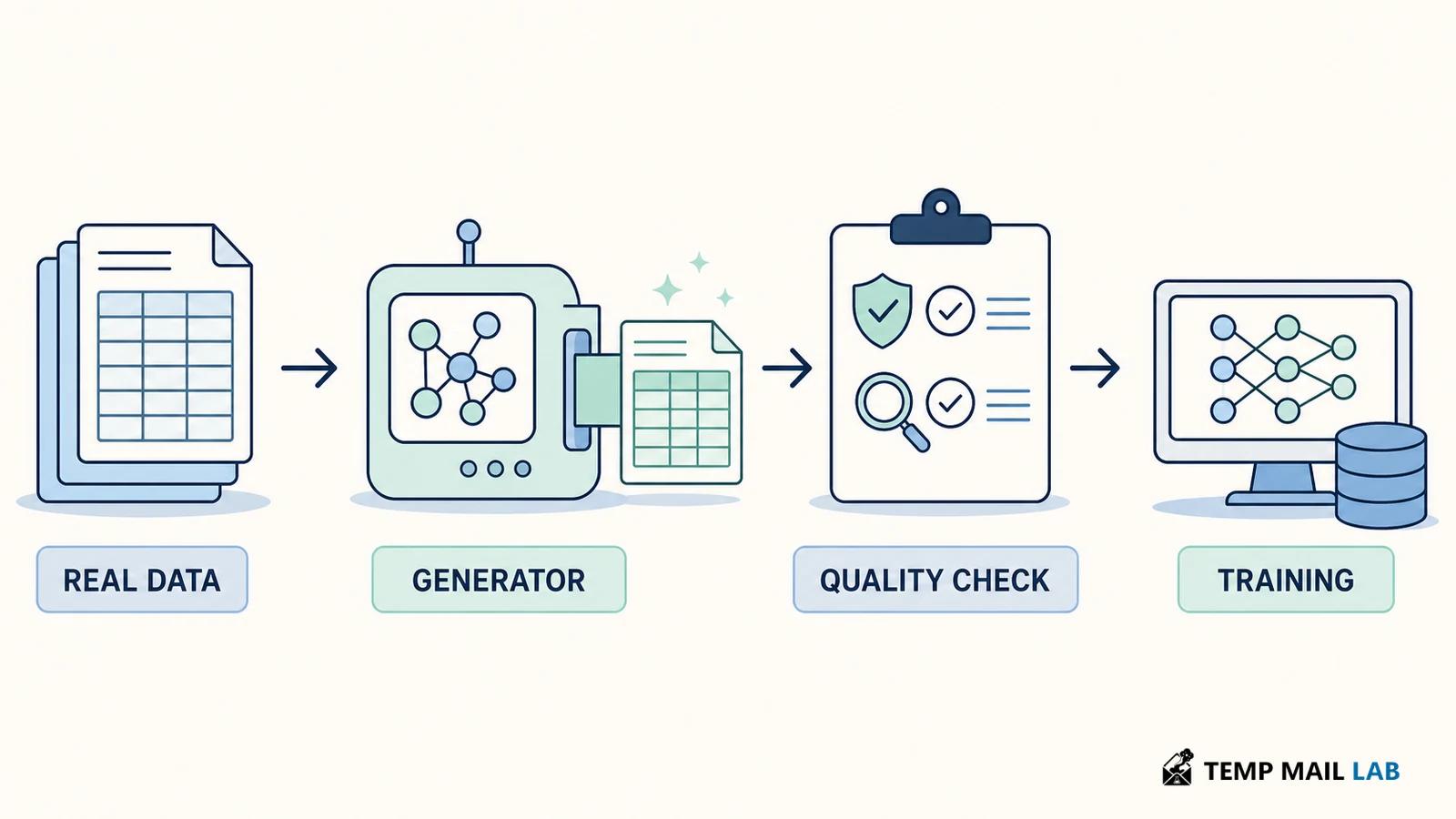
A useful synthetic-data project begins with a defined job. The team must know which gap the generated examples are meant to fill, which real evidence anchors them, and which evaluation will show whether the data improved the task rather than merely increasing the file count.
Define the missing data before generating examples
Synthetic data is information generated by a program or model rather than directly observed from a person, place, or event. A simulator can produce sensor readings for a robot. A rule-based script can create account records for testing. A generative model can produce an image, a transcript, or a question and answer pair. These examples are synthetic even when they look realistic.
The label says how the example was produced, not whether it is useful. A synthetic record may be tightly controlled and easy to audit, or it may contain subtle errors copied from the generator. It may represent a real distribution, a deliberately rare edge case, or a fictional combination that never occurs outside the simulation.
NIST describes synthetic data as one tool in a wider de-identification and governance process. Its guidance also warns that removing direct identifiers does not solve every privacy or re-identification problem. In practice, teams need to document the generator, the source data, the intended use, and the tests applied before synthetic records enter training.
Why more data is not always better evidence
Modern models consume data in several forms: pretraining text, image and caption pairs, audio, code, demonstrations, preference labels, and task-specific examples. Finding more files is not the same as finding more useful training signal. Public material may be duplicated, low quality, restricted by license, difficult to label, or concentrated in a few languages and topics.
There is no single published date when the world's useful training data will be gone. The exhaustion problem is better understood as a set of constraints. A team may run out of clean examples for a narrow domain long before the internet runs out of pages. A dataset can also become stale as products, slang, devices, and social conditions change.
Synthetic generation looks attractive because it can be repeated on demand. A team can ask for more examples of a rare failure, generate labels from a simulator, or produce controlled variations of an image. It can also create data where collecting the real version would expose private records or require a costly study. Those benefits are practical, but they do not turn generated examples into independent observations.
How recursive synthetic data can cause model collapse
A model's output is shaped by its training distribution. If a new model is trained only on outputs from an earlier model, the errors and omissions in those outputs can become the next model's reference point. The Nature study "AI models collapse when trained on recursively generated data" describes this as model collapse: later generations lose parts of the original distribution and amplify mistakes.
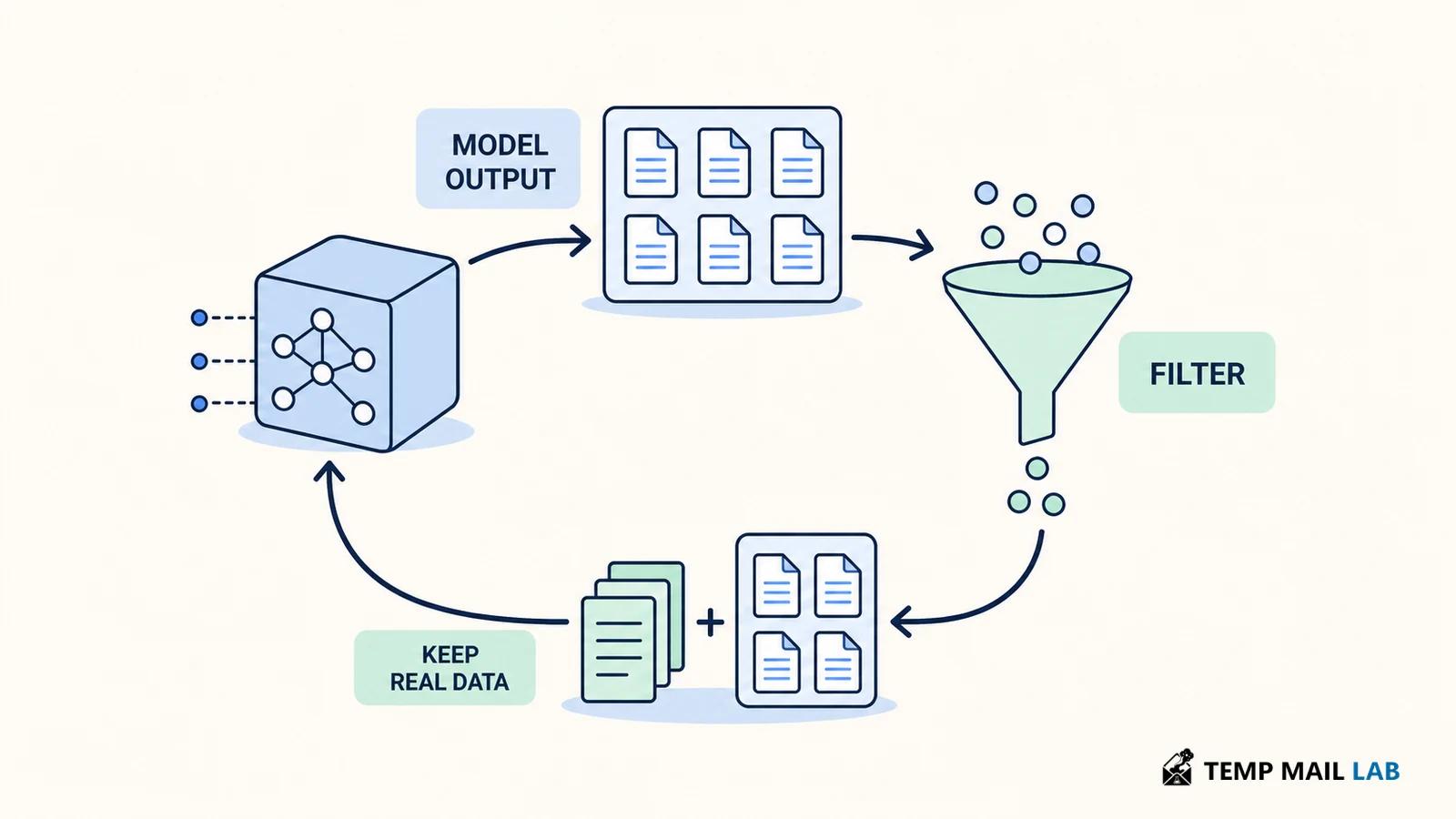
That result does not mean every synthetic example damages a model. Other research has found that keeping earlier real data alongside generated data can avoid the collapse seen when each generation replaces the last one. The distinction matters. Synthetic data can add coverage, but it should not quietly become the only record of what the world looks like.
For each generated batch, reviewers should be able to name the measurements, human judgments, or verified rules that anchor it. Without that trail, a larger batch may add volume while adding little independent evidence.
Where synthetic data still falls short
Images are not just text with pixels
Image training has its own bottlenecks. A picture may need a reliable caption, object boundaries, location or pose labels, camera context, and permission to use the image. Common web images often describe common objects under familiar lighting. They do not guarantee coverage of unusual viewpoints, damaged equipment, low light, crowded scenes, or local visual conventions.
Synthetic images can fill some of those gaps. A simulator can render a machine fault that is expensive to stage. A generator can vary weather, camera angle, or object placement while keeping a label known. Google Research has studied scaling laws for synthetic images in image classification and vision-language training, which shows why generated visual data is attractive for controlled experiments.
The limitation is that a generator has its own visual habits. It may produce clean backgrounds, typical faces, or simplified textures more often than real images do. A model trained heavily on those images may perform well on the same visual style and struggle when the camera, culture, material, or lighting changes.
Long-tail languages and communities
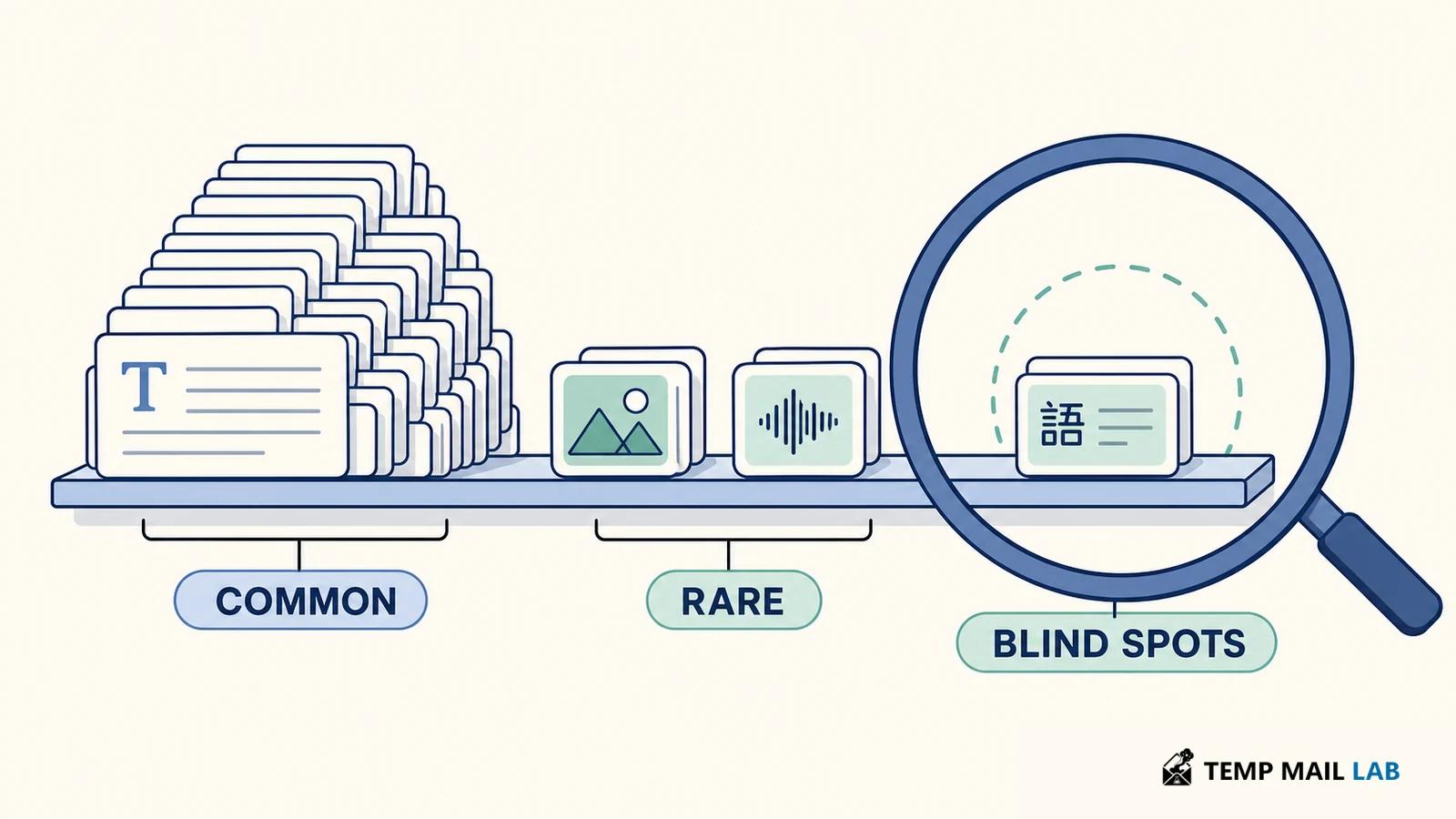
Web-scale text is not evenly distributed. Some languages, dialects, professions, and accessibility needs have far fewer public examples. Translation or generation can provide starting material, but the generated text may flatten local grammar or invent terminology. A fluent sentence is not proof that it represents the community it appears to describe.
The same issue applies to images of underrepresented people and places. If the source contains few examples, a generator can reproduce the majority pattern rather than discover the missing one. A larger synthetic set can make the imbalance less visible while leaving the underlying evidence thin.
Audio, video, and physical edge cases
Audio depends on microphones, rooms, accents, background noise, and speaking styles. Video adds timing, camera movement, and interactions between objects. Robotics and autonomous systems need unusual but physically plausible events, not just visually convincing frames. Simulators help, but the gap between simulation and deployment still has to be measured.
How to use synthetic data without replacing real data
Begin with a concrete failure, not a target number of generated files. Define the task, the population, and the errors that matter. Then choose the role synthetic data should play: supplying labels, creating rare cases, limiting exposure to private records, adding pretraining variety, or providing a test environment. Each role calls for different checks.
Keep a portion of real, verified data out of the generator loop. Use it as a fixed evaluation set that the model and the generator never see during creation. Compare performance by subgroup, language, lighting, device, and failure type, not only by one average score.
Track provenance. Record which generator and version produced each example, what prompt or simulation settings were used, which source data informed it, and what filters removed unsafe or low-quality records. NIST's work on synthetic content and provenance treats this history as part of trustworthy deployment, not optional paperwork.
For privacy-sensitive use, synthetic data is not automatically anonymous. A generator can memorize or reproduce unusual source records. Apply privacy review, limit access to the source dataset, test for memorization, and treat differential privacy as a specific technical guarantee rather than a synonym for synthetic.
Checks before synthetic data enters training
Before a generated dataset is mixed into training, ask:
- Does it add a capability that real data cannot provide as cheaply or safely?
- Which real evidence anchors its labels and distributions?
- Are synthetic and real examples separated in storage and metadata?
- Can reviewers identify generator artifacts?
- Is there a held-out real evaluation set?
- Are rare languages, visual conditions, and communities measured directly?
- Could the model be rewarded for copying the generator's style instead of learning the task?
- Is there a rollback plan if later data is found to be duplicated, biased, or contaminated?
A smaller, well-described batch can be more useful than a massive anonymous one. Quantity is easy to report. Coverage, independence, and error behavior take more work.
What teams should do when real data is scarce
Data exhaustion is a signal to improve curation, not permission to lower standards. Teams can collect new human examples with consent, license specialist datasets, build simulators, and use synthetic records to target gaps. They can also reduce duplication, deduplicate near-identical pages, and evaluate models on data that reflects current use.
Synthetic data works best as a controlled instrument. It can create a hard case, protect a sensitive field, or make a label explicit. It cannot by itself tell a model what the world is like, especially when the generator learned from the same narrow slice of the world.
A small-team pilot for synthetic data
Pick one measurable gap, generate a limited batch, document its provenance, and compare the result with held-out real data. If the batch does not reduce the target error without creating a new one, stop and revise the data plan.
Keep synthetic and real examples labeled separately so reviewers can trace failures back to the generator, the source data, or the training mix. This turns a broad claim about more data into a testable decision.
Research and technical guidance
- NIST: SP 800-188.
- NIST: Synthetic-content guidance.
- Nature: Model-collapse study.
- Google Research: Synthetic-image study.
- Google Research: Differentially private synthetic training data.